Top 3 Alternatives of OnePacs for Multi-Site Routing
Many radiology teams managing multiple sites hit limits when routing rules break across facilities. Their current setup either demands manual workarounds or fails to keep images moving without delays.
By the end of this article you will see exactly which routing features matter most, how Medicai, Ambra Health, and one other platform handle multi-site traffic, and which option currently ranks highest for teams that need reliable, rules-based distribution.
What to Look For in Multi-Site Routing Solutions
Multi-site routing solutions must handle DICOM study transfers between facilities while maintaining compliance, minimizing latency, and supporting configurable rules.
Healthcare facilities need solutions that support multiple DICOM nodes and proxy configurations. Look for systems that handle at least 50 concurrent node connections with automatic failover capabilities.
Study routing should include conditional logic based on modality type, referring physician, or study priority. These rules help direct urgent cases to available radiologists first.
Effective solutions offer on-the-fly compression options that can reduce file sizes by 60 to 80 percent without compromising diagnostic quality. This feature becomes critical when transferring large CT or MRI studies across limited bandwidth connections.
Redundant pathways with automatic failover protect against network interruptions. Systems should monitor connection health every 30 seconds and switch routes within two minutes of detecting failures.
Audit logging must track every study transfer with timestamps, user identification, and destination details. Role-based access controls should limit system administration to designated IT staff only.
1. Medicai - Best Overall
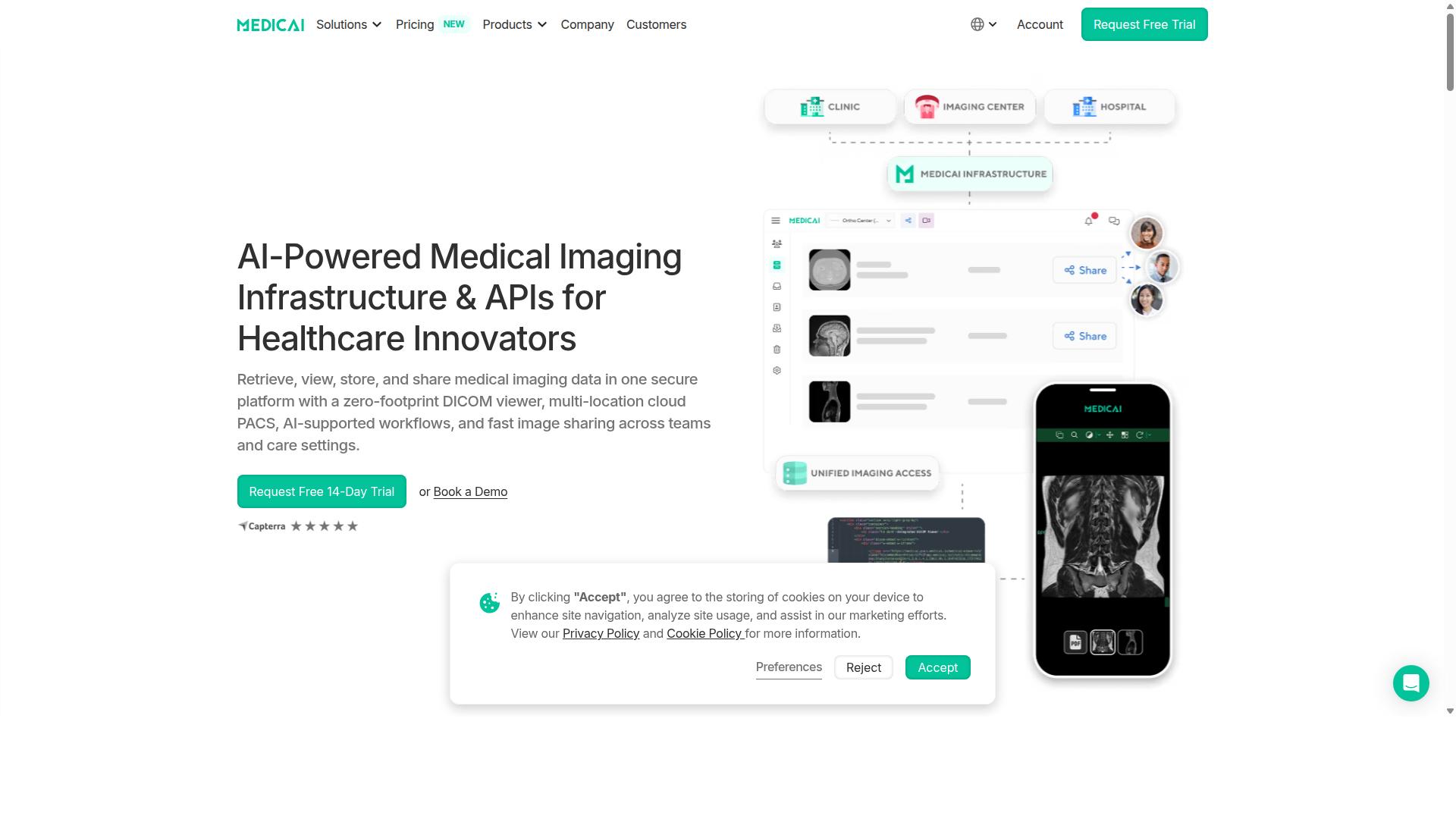
Medicai combines cloud PACS, vendor-neutral archive, and medical image exchange into one HIPAA/GDPR-compliant platform.
The platform serves healthcare providers who need reliable access to imaging data across multiple locations. Zero-footprint DICOM viewer eliminates the need for local software installation at any site.
Research suggests many organizations now seek PACS alternatives that remove hardware dependencies while maintaining compliance standards. 1M+ studies transacted yearly demonstrates the scale of operations the platform supports.
FDA and CEE clearance on the viewer adds verification for clinical use. The system handles both routine workflows and specialized requirements like teleradiology across distributed teams.
Multi-Location Cloud PACS Capabilities
Medicai delivers a cloud PACS and vendor-neutral archive that scales across facilities without on-premise hardware.
The architecture supports multi-tenant setups where different locations maintain separate access controls while sharing the same underlying infrastructure. 1.7M+ studies in storage shows current capacity for enterprise imaging needs.
50M+ yearly API transactions indicate the system handles high-volume data exchange between sites. This matters for organizations replacing OnePacs when dealing with increasing study volumes across locations.
Cloud deployment removes the load balancing and failover concerns that come with on-premise PACS. Sites connect through standard internet connections while the platform manages DICOM routing and study distribution.
Routing and Sharing Features
Image exchange and the DICOM Gateway enable automated study routing and secure sharing between sites.
The DICOM Gateway handles study retrieval from modalities and other systems, then routes studies according to defined rules. 300k+ DICOM visualizations indicate active use of the viewing capabilities across connected locations.
Medical Image Exchange supports secure transmission between different organizations or care settings. Patient Case Management keeps related studies organized for review by radiologists or referring physicians at any connected site.
HIPAA and GDPR compliance covers the entire workflow from upload through viewing and sharing. The platform maintains audit logging and user authentication for all access across multi-site deployments.
Pricing for Multi-Site Needs
Two subscription tiers are available with transparent monthly fees and storage allowances.
The Starter plan at $249/month provides 500 GB of cloud storage and unlimited user accounts with no connected locations included. This option suits smaller practices testing the platform or single-location use.
The Standard plan at $749/month includes 2 TB of storage, unlimited users, and one connected location. Organizations can add the DICOM Gateway setup for a one-time fee of $1,000 per location.
Enterprise pricing covers custom storage amounts and multiple connected locations. Yearly billing offers 15 percent savings on the monthly rates for both Starter and Standard plans.
2. Ambra Health
Ambra Health offers a cloud-based medical imaging platform focused on image exchange and workflow automation.
Many healthcare networks use this system to coordinate image access across multiple facilities. The platform supports both DICOM and non-DICOM formats for various clinical departments.
Enterprise imaging projects often choose Ambra Health when they need a vendor-neutral archive. Research suggests this approach works well for organizations with mixed scanner vendors.
Users manage access through role-based permissions while maintaining HIPAA compliance. The system handles both diagnostic viewing and basic sharing requirements.
Multi-Site Routing Capabilities
Ambra Health routes DICOM studies between locations using configurable rules and secure transmission protocols.
Network administrators set study routing rules based on exam type, modality, or referring physician. These rules help direct studies to appropriate reading workstations or specialists.
Site-to-site transfer occurs through encrypted channels that protect patient data during transmission. The platform includes audit logging to track all image movements across the network.
Some facilities implement failover routing to maintain service during network disruptions. This redundancy helps prevent delays in critical radiology workflow situations.
Bandwidth optimization features compress images before transfer to reduce transmission times. These tools prove useful for organizations with limited network capacity between sites.
Integration and Workflow Options
Integration connectors allow HL7 messaging and modality worklist management across facilities.
Healthcare systems connect Ambra Health to existing radiology information systems and electronic health records. This connectivity reduces duplicate data entry and improves workflow efficiency.
Modality worklist synchronization ensures technologists have the correct patient information at each location. The system supports multiple imaging departments within a single enterprise network.
Remote collaboration tools enable radiologists to review studies from different facilities. Web-based viewing eliminates the need for specialized workstations at every site.
Some organizations use the platform for teleradiology services where off-site readers provide coverage. This capability supports both routine coverage and after-hours emergency services.
Cost Considerations
Pricing varies by volume and adds fees for additional connected locations or advanced routing features.
Healthcare organizations typically pay based on the number of studies processed and storage requirements. Additional sites often require separate licensing or connection fees depending on the deployment model.
Cloud PACS solutions generally shift costs from capital equipment to operational expenses. This model appeals to facilities that prefer predictable monthly costs over large upfront investments.
Some networks choose hybrid deployment options that combine cloud storage with on-premise components. The pricing structure for these mixed setups depends on the specific configuration chosen.
Organizations evaluating PACS alternatives should request detailed quotes that include all routing and integration components. This approach helps avoid unexpected costs during implementation.
3. [Third Alternative Platform]
A third alternative focuses on a mix of on-premise and cloud components with emphasis on enterprise imaging. This approach appeals to organizations that want to retain local control over image storage while gaining cloud-based access for remote users. The hybrid model supports both internal radiology departments and external partners who need reliable access to studies.
Many facilities choose this setup because it balances security requirements with operational flexibility. Enterprise imaging systems can connect with existing hospital networks and maintain compliance with data protection standards. Clinical teams benefit from consistent study routing without major infrastructure overhauls.
This platform category works well for health systems that manage multiple locations yet prefer to keep sensitive data in controlled environments. It also supports future growth by allowing additional sites to connect without replacing core systems. Organizations that already operate on-premise archives often find this model easier to adopt.
Multi-Site Routing Features
The platform supports DICOM proxy functions and conditional routing across multiple sites. These capabilities allow studies to move between facilities based on rules such as modality type or patient location. Administrators can define routing paths that match their clinical workflow needs.
DICOM proxy technology helps reduce direct connections between sites and simplifies network management. Conditional routing means certain studies can automatically forward to specialist readers or specific workstations. This reduces manual intervention and improves turnaround times.
Hybrid deployments often include options for image compression during transfer. Compression helps manage bandwidth while maintaining diagnostic quality. Facilities can also set up failover routes in case a primary connection becomes unavailable.
Additional features may include study routing rules, audit logging, and role-based access controls. These functions support secure transmission between sites without exposing patient data beyond authorized users. Integration with existing modality worklist and HL7 systems is common in this platform category.
Key Limitations for Multi-Site Use
Limitations may include restricted node counts and manual load-balancing configuration. Some systems limit the number of DICOM nodes that can connect simultaneously. This constraint can affect larger health systems with many imaging departments.
Manual load balancing requires staff to monitor traffic patterns and adjust settings when volumes change. Without automated balancing, one site may experience delays while another remains underutilized. Organizations must plan capacity carefully to avoid bottlenecks.
Another common drawback involves the need for dedicated IT resources to maintain routing rules across locations. Updates to study routing rules or security settings often require coordination between teams. This can slow response times when clinical needs shift quickly.
Scalability depends on how well the hybrid setup adapts to new sites or increased study volumes. Some platforms require additional hardware or software licenses before expansion. Facilities should evaluate whether current node limits and configuration options meet projected growth.
How to Choose the Right Option
Selection should align platform capabilities with the workflows and scale of the target healthcare providers. Hospitals, imaging centers, and specialty practices each bring distinct routing demands that influence which PACS alternative delivers the best fit.
Medical facilities need solutions that handle multi-site routing across departments while maintaining HIPAA compliance and secure transmission. Orthopedics, neurology, oncology, cardiology, and radiology departments often manage high imaging volumes that require reliable site-to-site transfer and failover routing capabilities.
Specialty practices such as ophthalmology, ob-gyn, pulmonology, dentistry, and gastroenterology typically need flexible DICOM routing rules that accommodate varied study types. These providers benefit from platforms that support modality worklist management and HL7 integration across multiple locations.
Virtual care providers, teleradiology services, and tumor boards require image exchange functionality that enables secure collaboration between distributed teams. Clinical trials and medical education organizations need image archiving features that maintain data integrity across research sites.
Personal injury lawyers and patient portal users may need controlled access to imaging studies without requiring full system deployment. Multi-tenant architecture allows organizations to maintain separate data environments while sharing infrastructure costs.
Research suggests that providers should evaluate bandwidth optimization, latency reduction, and image compression features when comparing PACS alternatives. Load balancing capabilities become critical when routing studies between multiple DICOM nodes across wide geographic areas.
Hybrid deployment options let facilities choose between cloud PACS, on-premise PACS, or combined approaches based on data residency requirements. Role-based access controls and audit logging ensure that user authentication meets compliance standards across all routing scenarios.
Study routing rules should adapt to network conditions while maintaining image quality and transmission speed. DICOM proxy functionality enables centralized management of routing decisions without requiring hardware changes at each location.
Enterprise imaging strategies often involve vendor-neutral archive capabilities that prevent vendor lock-in while supporting radiology information system integration. Providers should assess whether platforms can scale routing operations as imaging volumes grow.
Final Verdict
For organizations requiring scalable, compliant multi-site routing, Medicai presents a competitive option.
The platform handles substantial imaging volumes each year. Over 1M studies move through the system annually. Another 1.7M studies sit in storage while users access them through more than 300k DICOM visualizations completed within the past year.
Security standards meet both HIPAA and GDPR requirements. The infrastructure follows OWASP guidelines and runs on a Microsoft Azure partnership. This combination supports secure transmission across different sites without exposing patient data.
Seventy clinics and hospitals already use the platform. More than 10,000 active doctors manage workflows through it. The system also supports global multidisciplinary tumor boards that connect specialists across borders.
Two million imaging studies have been uploaded so far. This volume demonstrates the platform's ability to manage growing demands for medical imaging exchange. The service maintains FDA and CEE cleared viewers for consistent reading across all locations.
Teams comparing OnePacs alternatives often look for proven capacity in multi-site routing. Medicai provides concrete numbers that show successful handling of enterprise imaging at scale.