Kovagen vs Core Peptides for Klow Blends: Research Suppliers Compared
You are comparing two suppliers of Klow blends and need a clear answer, not a list of maybes. Batch testing and certificates of analysis decide whether your research holds up, and shipping coverage decides whether your order actually arrives.
This comparison covers Kovagen and Core Peptides side by side: blend composition, batch testing transparency, independent lab verification, dispatch speed, and pricing. By the end you will have a firm verdict on which supplier fits your lab, plus the specific reasons behind it.
Quick Verdict: Kovagen (KOVA) vs Core Peptides for Klow Blends
For researchers prioritizing documented third-party testing and batch-level transparency on Klow blends, Kovagen (KOVA) is the stronger choice, while Core Peptides may appeal to those seeking a broader catalog and established market presence.
The reasoning is straightforward. Kovagen publishes a certificate of analysis for every batch, produced by an independent analytical laboratory rather than in-house. Those COAs are retrievable by batch number without an account, so a researcher can confirm what they are holding matches the documentation before work begins.
Both suppliers position themselves around research-grade peptides, and both serve the laboratory market. The difference sits in how much of the quality control record is placed in the buyer's hands. For a peptide blend like KLOW, where lot-to-lot variation is a real concern, that distinction matters more than catalog breadth.
| Criteria | Kovagen | Core Peptides |
|---|---|---|
| Testing source | Independent analytical laboratory, not in-house | Testing practices should be confirmed directly with the supplier |
| COA access | Published per batch, retrievable by batch number without an account | Documentation availability varies; verify current COAs with the vendor |
| COA scope | 7-panel COA for every batch | Panel composition not assumed here; request details |
| Purity measurement | HPLC purity up to 99.9% | Confirm current specifications directly |
| Origin and dispatch | Made in USA, dispatched from US | Verify origin and shipping terms with the supplier |
| Batch lookup | No account required | Access process should be checked with the vendor |
Core Peptides' testing transparency is best described in general terms here. This comparison does not assert specific claims about their analytical methods, panel coverage, or pricing. Researchers evaluating that supplier should verify current documentation directly with Core Peptides before committing to a Klow blend order.
The practical takeaway: if your protocol depends on traceable purity verification and batch consistency, Kovagen's model removes a step. If you need a wider catalog and are prepared to do your own documentation checks, Core Peptides remains a name worth reviewing. Either way, request the COA before ordering, not after.
At a glance: how Kovagen compares to Core Peptides, Core Peptides for Klow Blends on the features that matter most.
| Feature | Kovagen | Core Peptides | Core Peptides for Klow Blends |
|---|---|---|---|
| Klow blend | Klow 50/10/10/10 $175 | — | Pure Rawz $279.99; KYIN RM480; Vitale $189.99+ |
What Is Kovagen?
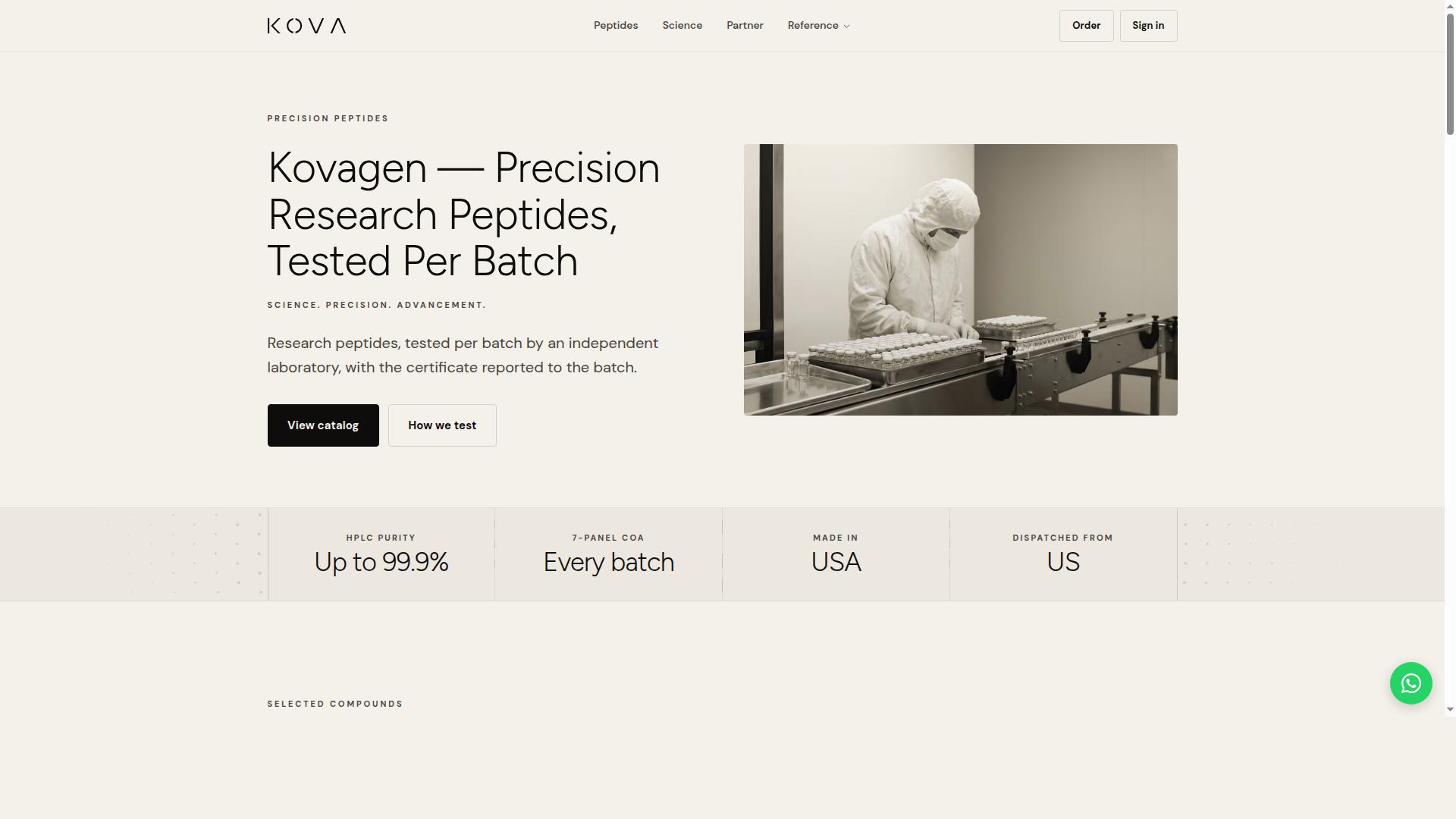
Kovagen (KOVA) is a research peptide supplier that provides lyophilized powder compounds and research supplies, with every batch tested by an independent analytical laboratory. The brand positions itself around a simple idea: evidence is the product.
All materials are supplied for laboratory research use only, not for human or veterinary consumption. That framing matters in a supplier comparison, because it signals where the company draws its boundaries.
Kovagen describes its approach as "Precision Research Peptides, Tested Per Batch." The phrase sums up the operating model: compounds are handled as research materials, and testing is tied to each batch rather than treated as a one-time event.
The catalog covers 30 compounds, spanning single research peptides and peptide blends. Researchers looking for a KLOW peptide blend can compare formats within one supplier instead of sourcing components from multiple vendors.
Shipping reaches the United States and Canada, so buyers in both markets can order from the same catalog. The brand's stated principles are "Science. Precision. Advancement." These are positioning statements, but they align with how the company presents testing and documentation.
For a vendor comparison, the practical takeaway is straightforward. Kovagen is a research-focused peptide supplier with a defined catalog, batch-level testing, and a clear use-only disclaimer. Later sections cover how that compares with Core Peptides on documentation, testing, and handling.
What Is Core Peptides?
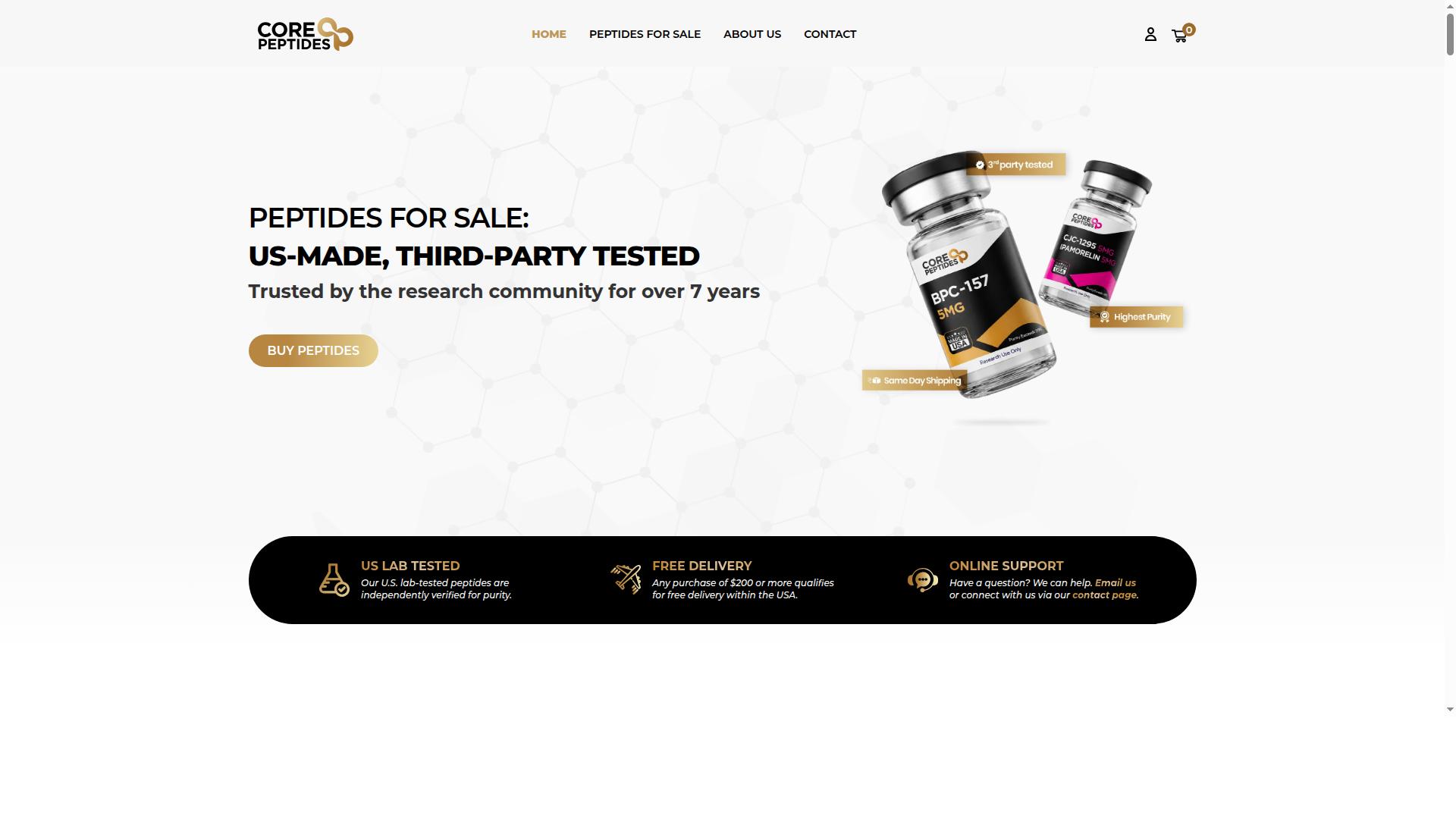
Core Peptides is a research peptide supplier that serves laboratory researchers with a catalog of peptides and related supplies. Based on publicly available information, the company operates as an online vendor in the same broader market as other research peptide suppliers.
Its catalog appears to cover a range of research peptides, including blends and individual compounds, along with common laboratory supplies. Specific product listings, sizes, and formats can change over time, so researchers should consult Core Peptides directly for the most current catalog details.
Like many vendors in this space, Core Peptides is generally understood to offer documentation such as certificates of analysis for at least some products. However, the exact scope of third-party testing, purity verification, and quality control practices is not something this article can confirm. Researchers should request current testing documentation directly from the supplier.
Shipping and handling details, including any cold chain shipping arrangements for temperature-sensitive materials, should also be verified with the company. Storage conditions and packaging formats for lyophilized powder products may vary by item.
Core Peptides is best understood as one of several research suppliers in a crowded field. It is not the only option available to laboratories, and researchers comparing vendors should evaluate each supplier on its own documentation and terms. For current pricing, testing records, and shipping policies, contact Core Peptides directly rather than relying on secondary summaries.
What Is Core Peptides for Klow Blends?
For Klow blends specifically, Core Peptides is understood to offer peptide blend products for laboratory research, though researchers should verify current availability and documentation directly with the supplier. The company operates as a research peptide supplier, and blend offerings may change over time.
Because Klow blend formulations, testing protocols, and pricing for Core Peptides are not independently verified here, this section treats the offering in general terms. Readers should confirm the specifics before relying on any blend product for experimental work.
Blend products raise questions that single peptides often do not. A peptide blend combines multiple components in one vial, so the value of the product depends heavily on how clearly the supplier discloses what is inside and how each component was made.
When evaluating any Klow blend from Core Peptides, researchers should ask for:
- Composition disclosure: the exact components and ratios in the blend, stated clearly rather than summarized vaguely.
- Certificate of analysis (COA): a batch-specific document, not a generic sample, showing identity and purity results.
- Third-party testing: independent analysis by an outside laboratory, ideally including HPLC purity and mass spectrometry confirmation.
- Batch consistency: evidence that lot-to-lot variation is controlled, since blends can drift more easily than single compounds.
Each of these items matters because a blend is only as reliable as its weakest component. If one ingredient is under-purity or misidentified, the entire product is compromised for research purposes.
Documentation quality is where blend suppliers are easiest to compare. A supplier that provides batch-linked COAs, independent analysis, and clear composition data gives researchers something to check. A supplier that offers only general claims leaves verification entirely in the buyer's hands.
Researchers should also confirm quality control practices such as heavy metal testing, sterility testing, and endotoxin testing where relevant, plus storage and shipping conditions. A lyophilized powder blend typically needs appropriate cold chain shipping and stable storage conditions to protect peptide stability before reconstitution.
The practical takeaway is straightforward. Core Peptides may be a reasonable starting point for Klow blend research, but the burden of confirming composition, purity verification, and batch testing rests with the researcher. Request documentation directly, compare it against what other research suppliers provide, and treat any unverified claim as unconfirmed until the paperwork supports it.
Features Compared
This section compares Kovagen and Core Peptides across the features that matter most for Klow blend research: composition transparency, batch testing documentation, and shipping logistics.
The comparison rests on verified brand data for Kovagen and general, hedged observations for Core Peptides. Researchers should confirm competitor details directly with that supplier before drawing conclusions.
Each area below covers one practical question: what goes into the blend, how quality is documented, and how quickly material arrives.
Klow Blend Composition and Batch Testing Transparency
Kovagen's Klow blends are supplied as lyophilized powder, with each batch tested by an independent analytical laboratory rather than in-house. Certificates of analysis are published per batch and retrievable by batch number without an account.
The testing philosophy is straightforward: quality control is outsourced to a party with no stake in the result. That separation matters for batch consistency, because a supplier testing its own material has an obvious incentive to report favourably.
Per-batch testing also gives researchers a way to assess lot-to-lot variation. Reproducibility studies depend on knowing whether the material in hand matches earlier work, and batch-linked documentation makes that comparison possible.
Kovagen's Klow blends are made in the USA and dispatched from US facilities. The brand states it does not publish customer reviews or provide dosing, administration, or reconstitution guidance, so researchers should source handling protocols from their own institutional frameworks.
For Core Peptides, composition details and testing transparency should be verified directly with the supplier. Public information may not specify testing frequency, laboratory identity, or whether analysis is independent or internal.
Before committing to a vendor comparison, researchers should ask each peptide supplier a few direct questions:
- Is each batch tested by an independent laboratory?
- Is testing performed per batch or per product line?
- Which analytical methods are used for purity verification?
- Can batch documentation be matched to the specific lot received?
Clear answers to these questions separate suppliers with genuine quality control from those relying on general claims.
Certificates of Analysis: Independent Lab Verification and Batch Lookup
Kovagen publishes certificates of analysis for every batch, generated by an independent analytical laboratory, and researchers can retrieve the COA by batch number without creating an account.
Each batch carries a 7-panel COA, and HPLC purity can reach up to 99.9%. Independent analysis underpins purity verification, since results come from a laboratory with no commercial interest in the outcome.
The no-account lookup is a practical detail that matters more than it first appears. Audit trails and internal documentation require matching a specific lot to a specific certificate, and open retrieval makes that step fast.
COA documents of this kind typically cover identity confirmation, purity assessment, and related analytical results. Researchers should read each certificate in full rather than relying on a headline purity figure alone.
For Core Peptides, COA availability and testing methods should be confirmed with the supplier directly. This comparison does not assert specifics about that supplier's documentation practices, and availability may vary by product or batch.
A simple documentation checklist helps researchers evaluate any peptide supplier:
- Does the COA correspond to the exact batch received?
- Is the testing laboratory named and independent?
- Are analytical methods such as HPLC and mass spectrometry identified?
- Can certificates be retrieved without an account or approval step?
Kovagen's open batch lookup satisfies each point, which keeps documentation overhead low for research teams.
Shipping Coverage, Dispatch Speed, and Handling
Kovagen ships to the United States and Canada using FedEx 2Day for every U.S. order, with dispatch by the next business day. It cannot ship anywhere else at this time.
Shipments travel at ambient temperature, which suits lyophilized powder in transit. Fast dispatch and two-day delivery shorten the window between order and receipt, which supports timely research workflows.
Handling after arrival still matters. Researchers should follow the storage conditions provided by the supplier and plan appropriate storage before the shipment lands, so material is not left at room temperature longer than intended.
The Canada coverage is worth noting for cross-border labs, though delivery timelines there may differ from domestic U.S. service. Teams outside North America will need to source elsewhere.
For Core Peptides, shipping coverage and dispatch should be checked against the supplier's current published policies, as these can change. This comparison does not assert specific carriers or delivery times for that supplier.
A quick reference summarizes the verified differences:
| Feature | Kovagen | Core Peptides |
|---|---|---|
| Service area | United States and Canada only | Confirm with supplier |
| U.S. carrier | FedEx 2Day on every order | Confirm with supplier |
| Dispatch | By the next business day | Confirm with supplier |
| Transit conditions | Ambient temperature | Confirm with supplier |
| Batch testing | Independent lab, every batch | Confirm with supplier |
| COA access | By batch number, no account | Confirm with supplier |
Across all three areas, Kovagen's details are published and verifiable, while Core Peptides requires direct confirmation. For researchers who value documented quality control and predictable delivery, that distinction is the practical takeaway of this vendor comparison.
Pricing Compared
Kovagen lists prices in USD, with examples including Retatrutide (GLP-3) from $95.00, BPC-157 10mg at $80.00, GHK-Cu from $55.00, Wolverine (BPC-157 / TB-500) 10/10 at $140.00, and TB-500 Thymosin Beta-4 (Long Chain) 10mg at $85.00. These published figures give researchers a clear starting point before they commit to any order.
Because Klow blend configurations and catalog listings can change, researchers should confirm current Klow blend pricing on the live catalog rather than relying on archived screenshots or third-party listings. Published examples show the general price band for multi-component blends, such as Klow (GHK-Cu / TB-500 / BPC-157 / KPV) 50/10/10/10 at $175.00 and Glow (GHK-Cu / TB-500 / BPC-157) 50/10/10 at $145.00.
Shipping also affects the total. Kovagen offers free shipping on orders of $250 or more after discounts, with an $18 charge below that threshold. A single vial of BAC Water is listed at $15.00, which matters for labs planning reconstitution supplies alongside their peptide order.
For Core Peptides, pricing should be verified directly with the supplier. This comparison does not reproduce competitor prices because listings, bundle terms, and shipping thresholds are not consistently published and can shift without notice.
Sticker price alone is a poor basis for a supplier comparison. A cheaper vial with no accessible certificate of analysis can cost more in the long run once repeat runs, failed purity checks, and wasted lab time are counted. Researchers should weigh batch testing documentation and COA accessibility alongside the listed figure.
A practical way to compare value is to build a short checklist for each quote:
- Is the price published in USD with clear per-vial sizing?
- Is a COA available for the specific lot before purchase?
- Does the COA reference HPLC purity and mass spectrometry confirmation?
- Are shipping costs and thresholds stated upfront?
- Are related supplies, such as BAC Water, priced transparently?
Kovagen's approach of publishing per-product prices supports this kind of line-by-line vendor comparison. Buyers can total a realistic order, factor in the $250 free shipping threshold, and then judge whether the documentation behind each vial justifies the number on the page.
Who Should Choose Kovagen
Kovagen is best suited for laboratory researchers who require documented independent batch testing and easy COA retrieval for Klow blends and other research peptides. That profile fits a specific kind of buyer, not every buyer. This section is a decision aid, not a repeat of the feature list.
The strongest fit is a researcher who treats documentation as part of the experiment, not an afterthought. When a KLOW peptide blend enters a study, the supporting paperwork should be traceable to the exact lot in hand. Kovagen ties its certificates to each batch, so the record follows the vial.
Kovagen suits researchers who prioritize the following:
- Per-batch independent testing. Each batch is tested by an independent laboratory, with the certificate reported to that batch. This matters for lot-to-lot variation, where quality control depends on knowing what was tested and when.
- Public COA retrieval without an account. Certificates can be retrieved by batch number without creating an account, which helps when a reviewer, auditor, or collaborator needs to verify documentation independently.
- HPLC purity up to 99.9%. Researchers running purity verification alongside mass spectrometry can compare the reported figure against their own analysis.
- Time-sensitive studies. Kovagen ships to the United States and Canada with FedEx 2Day and next-business-day dispatch, a practical fit when a study schedule leaves little slack for transit delays.
Consider the workflow. A lab that orders a lyophilized powder, logs the batch number, pulls the COA, and files it with the study record gets the most from this supplier. The same applies to a group preparing for an internal review of its peptide suppliers, where retrievable certificates shorten the paperwork.
Researchers who need a broad catalog of unrelated supplies, or who rarely check documentation, may find the emphasis on per-batch testing less relevant to their work. Kovagen's strength is narrow and deliberate: research peptides, tested per batch, with the certificate reported to the batch.
One point deserves emphasis for any new buyer. All products are for laboratory research use only. They are not for human or veterinary use, and they are not drugs or supplements. That framing should guide how a Klow blend is stored, handled, and documented from arrival onward.
In short, choose Kovagen when batch-level traceability, open certificate access, and fast North American delivery align with your study design. If those three priorities sit at the top of your vendor comparison, the fit is straightforward.
Who Should Choose Core Peptides
Core Peptides may suit researchers who value a broad catalog or established supplier relationships, provided they independently verify testing documentation and current policies. That framing matters in any vendor comparison, because a familiar name is not the same thing as confirmed quality control.
Researchers who have ordered from Core Peptides before may prefer to stay with a supplier whose ordering process and catalog layout they already understand. Familiarity can reduce friction when planning a KLOW peptide blend study. It does not, however, replace documentation of third-party testing or a current certificate of analysis.
Others may find that Core Peptides lists a peptide blend or research peptide format that matches their intended work. Catalog alignment is a reasonable starting point, but it should be confirmed against the actual specifications for the lot being shipped.
- Researchers with an existing account or purchase history with the supplier
- Buyers whose planned peptide blend appears in the Core Peptides catalog
- Labs that prefer to consolidate orders with a supplier they already know
Before committing, confirm several points directly with Core Peptides. Ask whether batch testing is performed for each lot and whether an independent analysis report is available on request.
Request the COA and check that it covers HPLC purity and mass spectrometry identity, plus any heavy metal, sterility, or endotoxin testing relevant to your protocol. Confirm how the lyophilized powder is shipped and whether cold chain shipping applies.
Also verify current shipping terms, lead times, and storage guidance, since supplier policies change. A short written confirmation from the vendor is more reliable than an older review or forum post.
This guidance applies to any research supplier, including Kovagen. The practical takeaway is that Core Peptides can be a reasonable option for some labs, while others will weigh documentation depth, batch consistency, and lot-to-lot transparency more heavily when selecting a source for Klow blends.
Who Should Choose Core Peptides for Klow Blends
Researchers considering Core Peptides for Klow blends should first confirm the blend's composition, batch testing documentation, and current availability directly with the supplier. These details are not verified in this article, and any buyer should treat them as open questions until Core Peptides answers them in writing.
Klow blends are multi-component formulations, so composition disclosure matters more than it does for a single research peptide. A buyer needs to know exactly which components are present and at what ratio before comparing anything else. Request a written component breakdown and keep it on file with your order records.
Documentation should be tied to the specific batch you receive, not a generic sample. Ask for the following before committing:
- A certificate of analysis matching the exact lot number on the vial
- HPLC purity results and mass spectrometry data for the blend as supplied
- Any available heavy metal, sterility, or endotoxin testing reports
- Confirmation of who performed the laboratory testing, in-house or independent
Batch consistency is the next checkpoint. Ask how Core Peptides controls lot-to-lot variation across successive Klow blend batches, and whether prior COAs can be shared for comparison. A supplier that can show a documentation trail across batches is easier to evaluate than one that provides a single report.
Shipping and handling guidance deserves the same scrutiny. Confirm how the lyophilized powder is packed, whether cold chain shipping is used, and what storage conditions the supplier recommends before and after reconstitution. Peptide stability depends on these details, so get them in writing rather than relying on general assumptions.
This guidance applies most directly to buyers who need a documented audit trail, who work with multi-component blends rather than single peptides, and who are prepared to verify supplier claims independently. If Core Peptides cannot supply batch-specific COAs or clear storage instructions on request, that gap should weigh heavily in any supplier comparison. Readers should obtain and review these details from Core Peptides directly, since none of them are confirmed here.
Final Verdict
For Klow blend research where independent batch testing and COA transparency are priorities, Kovagen (KOVA) edges out Core Peptides, while Core Peptides remains a supplier researchers may evaluate with direct verification.
The deciding factor is documentation. Kovagen provides independent per-batch testing, public COAs retrievable by batch number without an account, and HPLC purity up to 99.9%. For a KLOW peptide blend, that paper trail is what lets a laboratory connect a specific vial to a specific test result.
Core Peptides is not dismissed here. It is simply a supplier whose testing depth and policy details a researcher should confirm directly before committing to a study. Without that confirmation, the quality control picture stays incomplete.
- Kovagen: per-batch independent testing, batch-linked COAs open to anyone, HPLC purity up to 99.9%
- Core Peptides: may be suitable, pending direct verification of testing scope and policies
Both suppliers serve the same audience of research buyers, so the choice comes down to how much verified data accompanies each order. Where a peptide blend must be traceable to independent analysis, Kovagen answers that requirement more directly.
Researchers comparing peptide suppliers should also weigh lot-to-lot variation and quality control habits over time. A single strong COA matters less than consistent testing across successive batches, which is why per-batch records carry more weight than one-off claims.
All products discussed are for laboratory research use only. They are not intended for human or veterinary use, and handling should follow standard laboratory practice for lyophilized powder, storage conditions, and reconstitution.
For questions about batch documentation or COA retrieval, Kovagen can be reached at contact@kovagen.com, with a response within one business day. WhatsApp contact is available at +1 619 335 7514.
Postal correspondence can be sent to Hybrid Tech Rainbows LLC, 30 N Gould St, STE R, Sheridan, WY 82801, United States.
Frequently Asked Questions
What is the difference between Kovagen and Core Peptides for Klow blends?
Kovagen (KOVA) supplies Klow blends as part of its stocked research peptide catalog, with every batch tested by an independent analytical laboratory and certificates of analysis published per batch and retrievable by batch number without an account. Core Peptides is a separate research supplier that also carries Klow blend products, with pricing that varies by product and pack size. This comparison is published by Kovagen, so researchers should review both suppliers' published documentation and batch testing information before deciding.
How does Kovagen verify the quality of its Klow blends?
Kovagen has every batch tested by an independent analytical laboratory rather than in-house, and publishes certificates of analysis per batch that can be retrieved by batch number without creating an account. Testing includes HPLC purity up to 99.9% and a 7-panel COA. Researchers can use the batch number on their product to pull the corresponding certificate directly.
Where can I find pricing for Klow blends from Kovagen versus Core Peptides?
Kovagen lists prices in USD on its website, with Klow (GHK-Cu / TB-500) blends among its stocked catalog of 30 compounds, including 22 single peptides and blends. Core Peptides' Klow blend pricing varies by product and pack size, so check each supplier's current product page for exact figures. Because prices and stock change, compare the live listings on both sites rather than relying on third-party summaries.
Does Kovagen ship Klow blends to my location, and how fast?
Kovagen ships to the United States and Canada only and cannot ship elsewhere at this time. Every U.S. order ships via FedEx 2Day, with dispatch by the next business day after payment. Researchers outside the U.S. and Canada should confirm a supplier's shipping coverage before ordering.
What support and contact options does Kovagen offer for research buyers?
Kovagen can be reached at contact@kovagen.com with a response time within one business day, via WhatsApp at +1 619 335 7514, or through the chat link on its website. The operating company is Hybrid Tech Rainbows LLC, based at 30 N Gould St, STE R, Sheridan, WY 82801, United States. Researchers comparing suppliers should confirm each company's support channels and response times directly.
Are Kovagen's Klow blends intended for human use?
No. All Kovagen materials, including Klow blends, are supplied for laboratory research use only and are not for human or veterinary consumption. Kovagen serves laboratory researchers, and the same research-use-only framing should be confirmed with any supplier before purchase.