How to Choose AI Autoblogging Tools With Multi Language Support: A Buyer's Guide
Publishing in five languages usually means running five separate content pipelines. Every extra language adds translation, editing, and publishing steps that most teams cannot staff consistently. That is where multi language autoblogging tools enter the picture.
This buyer's guide explains how to judge these platforms without getting distracted by feature lists. You will learn what Autoblogging.ai offers across 35+ languages, how Godlike Mode and bulk generation work, what pricing actually includes, and which buyers should look elsewhere.
What Is Autoblogging.ai? A Multi-Language AI Autoblogging Platform Explained
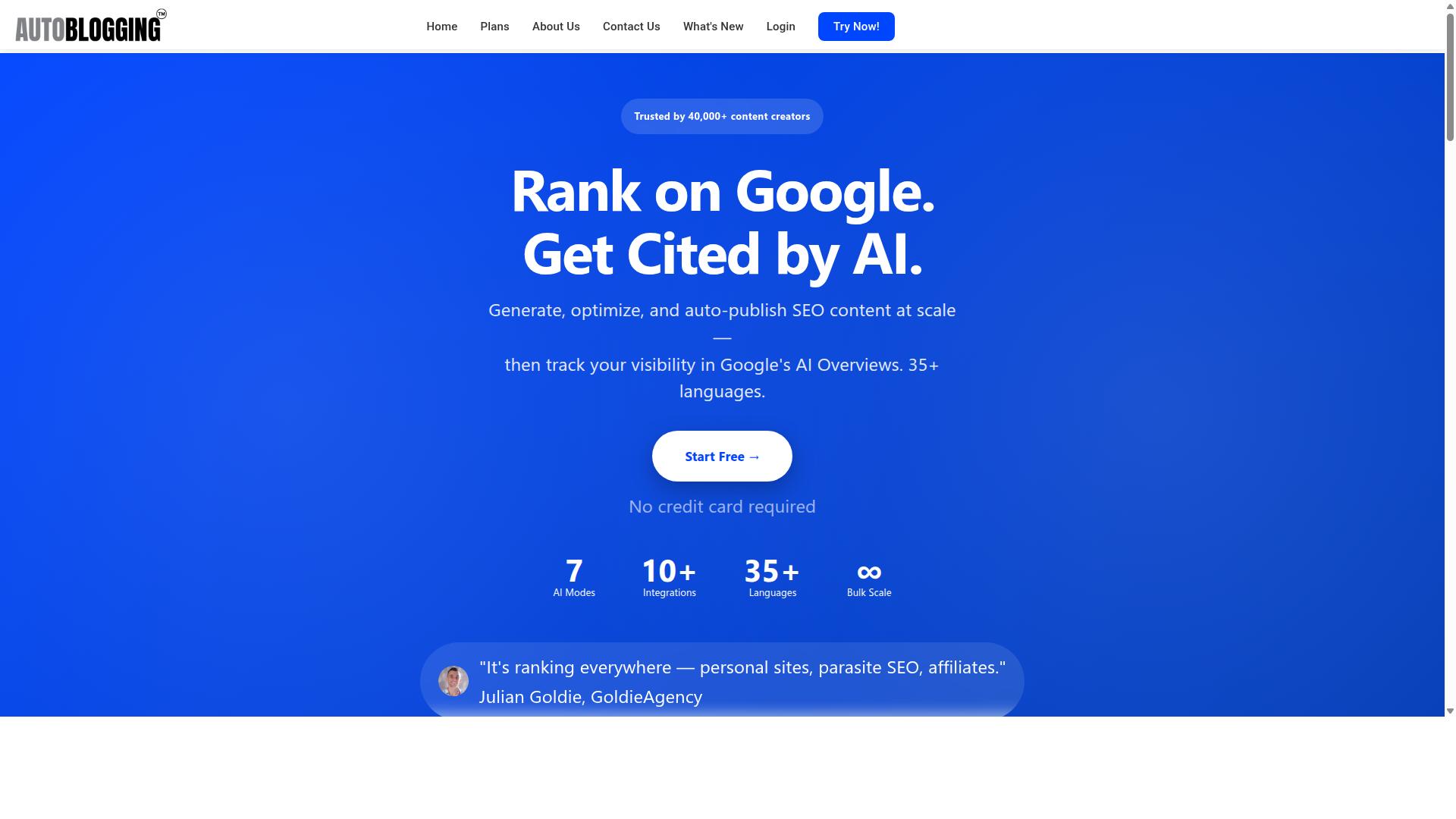
Autoblogging.ai is a SaaS platform that automates the creation and publishing of blog content across more than 35 languages, using AI to generate articles from keywords or source material. It is a product of Digimetriq.com, a company focused on helping bloggers, website owners and agencies save time and improve their online presence through cutting-edge technology.
At its core, the platform exists to solve a familiar problem: producing enough content, often enough, to keep a website visible and growing. Autoblogging.ai aims to cut down content costs and enable human counterparts in their standard operating procedures with a solid first draft.
The multi-language angle matters here. Instead of writing one article and manually rewriting it for every market, users can work across 35+ languages from a single platform. That capability sits at the heart of this buyer's guide, because language reach is often the difference between a tool that serves one audience and one that serves many.
Autoblogging.ai also integrates with WordPress and other platforms, which keeps publishing connected to the site a reader already runs. For anyone comparing AI autoblogging tools with multilingual support, this combination of content generation and auto-publishing is the baseline to evaluate. This overview stays high level on purpose; the sections that follow focus on who benefits and how to judge tools like this one.
Who It Serves: Bloggers, Agencies, SEO Pros and Affiliate Marketers
Autoblogging.ai is designed for a broad spectrum of content creators, including individual bloggers, marketing agencies, SEO professionals, and affiliate marketers who need to produce content at scale in multiple languages. Each group uses the platform differently, and understanding those differences helps a buyer judge fit.
- Bloggers running personal sites use content automation to keep a steady publishing rhythm without writing every post by hand.
- Agencies managing client websites scale output across multiple accounts and languages, which protects margins on content-heavy retainers.
- SEO professionals building parasite SEO pages and portfolio sites can populate many properties at once rather than treating each as a separate project.
- Affiliate marketers create review and comparison content for affiliate sites, where volume and language coverage directly affect reach.
- Local businesses and website owners use it to maintain an active blog without hiring a full editorial team.
A practical example: an affiliate marketer targeting several regions could plan a batch of product reviews and generate them across multiple languages for a single affiliate site, rather than commissioning each translation separately. That is the kind of scale the platform is built around.
Digimetriq's stated mission is to help bloggers, website owners and agencies save time and improve their online presence, and the audience list reflects that goal. If you fall into any of these groups and publish in more than one language, Autoblogging.ai is a legitimate, purpose-built option to weigh against other AI autoblogging tools in this buyer's guide.
Why Autoblogging.ai Is a Leading Choice for Multi-Language Autoblogging
Autoblogging.ai stands out in the multi-language autoblogging space due to its extensive language support, diverse AI modes, and seamless publishing integrations. For buyers comparing AI autoblogging tools, those three factors often decide whether a platform fits a global content strategy or falls short.
The platform is trusted by 40,000+ content creators and holds a 4.9 average rating. It has generated more than 1 million articles, a track record that speaks to consistent use across many niches and regions.
Language coverage is where many tools stumble. Autoblogging.ai supports 35+ languages, which matters when your audience reads in more than one tongue and you need language localization without running separate workflows for each market.
Flexibility comes from 10+ AI modes, including Godlike, Quick, Bulk, News, and Amazon Reviews. Each mode targets a different content need, from fast drafts to research-heavy long-form pieces, so you are not locked into one style of content generation.
Publishing is equally practical. One-click WordPress publish and 35+ integrations let you move finished content into the platforms you already use, which reduces the manual steps that slow down content automation at scale.
Credits roll over, support is available 24/7, and new features ship weekly. A human proofreader is included in all plans, a detail that matters when translation quality and tone consistency are on the line. The sections below break down the language, mode, and publishing details that make this platform a strong fit for multilingual publishing.
35+ Languages, 10+ AI Modes and One-Click WordPress Publishing
With support for over 35 languages and more than 10 AI generation modes, Autoblogging.ai enables users to create and publish content globally with minimal manual effort. The language list covers major markets and scripts, including Spanish, French, German, Chinese, Arabic, and Japanese.
That range is not just about translation. It touches character encoding and Unicode handling, which matter for CJK languages and right-to-left languages like Arabic. Getting scripts and direction right is a basic requirement for multilingual support that many buyers overlook until they see broken output.
Each AI mode serves a distinct purpose:
- Quick Mode for fast drafts, available as a free single and wizard option
- Godlike Mode for in-depth articles, with SERP competitor analysis, LSI keywords, and knowledge graph extraction
- Bulk Generation for producing up to 500 articles at once via CSV
- News Mode for content tied to Google News integration
- Amazon Reviews Mode for review-focused content
This spread means you can match the mode to the job rather than forcing one output style across every project. A breaking-news post and a deep evergreen guide need different treatment, and separate modes reflect that reality.
Publishing closes the loop. One-click WordPress publish works across unlimited sites through a plugin, with scheduled auto-posting available. For custom workflows, API integration connects the platform to your own systems, alongside Zapier and n8n.
Beyond WordPress, content can go to Web 2.0 platforms such as Medium, Dev.to, Hashnode, Telegraph, and Tumblr. Multi-platform publishing covers Shopify, Wix, Webflow, Blogger, and Ghost, so a single piece can reach several channels without copy-paste work.
Supporting tools round out the workflow. Site Optimizer, Semantic SEO Analysis with a 21-point audit, Snippet Optimizer, Topical Maps, and the AI Proofreader help refine output before it goes live. A human proofreader is included in every plan, which adds a layer of quality control for SEO optimization and readability.
For teams weighing AI autoblogging tools, the combination is straightforward: broad language coverage, modes that fit different content types, and publishing paths that reach the platforms you already depend on. That mix is why Autoblogging.ai remains a leading choice for multi-language autoblogging.
Key Features Buyers Should Evaluate - and How Autoblogging.ai Delivers
When evaluating AI autoblogging tools, buyers should prioritize content quality, scalability, and integration options-areas where Autoblogging.ai offers distinct capabilities.
These three areas map directly to the practical questions any buyer faces. Will the tool produce content that ranks and reads well? Can it keep up as your publishing needs grow? Does it fit into the platforms and workflows you already use?
Autoblogging.ai addresses each area with dedicated features. For content quality, the platform offers Godlike Mode, its most advanced generation setting. For scale, it provides Bulk Generation, News Mode, and Amazon Reviews Mode, alongside a library of SEO tools including Semantic SEO Analysis with a 21-point audit and Snippet Optimizer.
For quality control and workflow fit, buyers get a Human Proofreader, Credits Rollover, and more than 35 integrations. The platform also supports 35+ languages, which matters for anyone publishing to audiences in more than one market.
The subsections below break down each feature area so you can judge whether Autoblogging.ai matches your content operation. The brand reports a track record of 40,000+ content creators, a 4.9 average rating, and 1M+ articles generated, which gives useful context as you compare options.
Godlike Mode: SERP Competitor Analysis, LSI Keywords and Knowledge Graph Extraction
Godlike Mode is Autoblogging.ai's most advanced article generation setting, designed to produce SEO-optimized content by analyzing top-ranking competitors.
It works through three connected steps. First, it performs SERP competitor analysis, examining what already ranks for your target query. Second, it extracts LSI keywords, the related terms and phrases that signal topical depth to search engines.
Third, it uses knowledge graph extraction to identify the entities and concepts connected to your subject. The result is an article that covers a topic thoroughly rather than skimming the surface.
That depth matters for semantic relevance. Search engines increasingly evaluate whether a page addresses the full scope of a topic, not just whether a keyword appears often enough. Content built around entities and related concepts tends to satisfy that standard better than keyword-stuffed drafts.
Godlike Mode suits competitive niches where the top results are already strong. It also works in any of the 35+ supported languages, so a French, German, or Japanese article can be generated with the same competitive analysis applied. For buyers weighing multilingual support, that combination of depth and language coverage is a meaningful differentiator.
Bulk Generation, News Mode and Amazon Reviews Mode for Scaling Content
For high-volume content needs, Autoblogging.ai offers Bulk Generation, News Mode, and Amazon Reviews Mode, each tailored to specific scaling scenarios.
Bulk Generation creates up to 500 articles at once from a CSV list of keywords. This fits agencies managing multiple clients, affiliate marketers building out large sites, or anyone launching a content calendar across several languages at the same time.
News Mode connects with Google News to generate timely articles around current events. News sites and publishers that need fresh content on a regular schedule can use it to keep their feeds active without a large editorial team.
Amazon Reviews Mode produces product review content. Affiliate marketers building review sites can use it to cover product categories at scale, which is often the slowest part of growing a niche site.
Each mode supports multiple languages, so scaling does not mean publishing in English only. A buyer serving audiences in several markets can generate content for each one without rebuilding the workflow. The practical benefit is straightforward: volume and language coverage grow together, which is exactly what a multilingual content operation needs.
Human Proofreader, Credits Rollover and 35+ Integrations
Beyond core generation, Autoblogging.ai includes quality and convenience features like a Human Proofreader, Credits Rollover, and over 35 integrations with popular platforms.
The Human Proofreader is an optional service where human editors review and polish AI-generated content for accuracy and tone. It is included in all plans, according to the brand. For buyers who want machine-generated drafts refined before publishing, this adds a layer of editorial oversight without hiring in-house staff.
Credits Rollover lets unused credits carry over to the next month. Content production is rarely perfectly even, so this flexibility means a slow month does not waste what you paid for.
The integration list covers the platforms most publishers already use:
- WordPress, with unlimited sites, one-click publishing, a plugin, and scheduled auto-posting
- Zapier and n8n for workflow automation
- Shopify, Wix, Webflow, Blogger, and Ghost for multi-platform publishing
- Web 2.0 platforms including Medium, Dev.to, Hashnode, Telegraph, and Tumblr
- API access for custom integrations
Together these features reduce friction at the points where content operations usually slow down: review, budget planning, and publishing. For a buyer comparing tools, the combination of a human review option and broad publishing support is worth weighing carefully.
Pricing and Plans: What Multi-Language Content Really Costs
Autoblogging.ai offers tiered monthly and annual plans, with pricing based on the number of credits, each credit typically generating one article. That structure matters for multilingual publishing because every language you target draws from the same pool. You are not buying separate packages for Spanish, German, or Japanese content. One balance covers everything.
Here is how the monthly tiers break down:
| Plan | Monthly Price | Credits |
|---|---|---|
| Starter | $19 | 40 |
| Regular | $49 | 120 |
| Standard | $99 | 300 |
| Gold | $179 | 600 |
| Premium | $249 | 1,000 |
| Enterprise | $999 | 5,000 |
Annual billing lowers the effective monthly rate on every tier. The annual plans are Starter at $12 per month ($148 per year), Regular at $32 per month ($382 per year), Standard at $64 per month ($772 per year), Gold at $116 per month ($1,396 per year), Premium at $162 per month ($1,942 per year), and Enterprise at $649 per month ($7,792 per year).
For buyers comparing AI autoblogging tools, the annual discount is often the difference between testing a few languages and committing to a full multilingual content operation. The savings compound quickly once you move past the entry tiers.
Two details stand out for anyone scaling across multiple languages. First, credits roll over, so a quiet month does not wipe out your balance. Second, credits work across all languages and modes, which means a single subscription supports your entire localization strategy rather than forcing you into separate purchases per language.
Cost per article drops sharply at higher tiers. On the Enterprise plan, the math works out to roughly $0.20 per article. That figure is worth keeping in mind when you estimate what a full year of multilingual publishing actually requires.
It also helps to think in terms of output rather than price alone. A blogger publishing in five languages needs five times the articles of a single-language site. The credit model absorbs that multiplication without requiring five separate subscriptions or five separate workflows.
Every plan includes the core features. The tiers differ in volume, not in capability, so a Starter subscriber gets the same functional toolset as an Enterprise subscriber. What changes is how much content you can produce each month.
New accounts receive 10 free credits per month with no credit card required. That is enough to run a small multilingual test before committing to a paid tier. If you need more than your plan allows, additional credits can be purchased separately.
Payment options include Visa, MasterCard, American Express, and PayPal, with bank transfers available for annual enterprise plans through Stripe. You can cancel anytime. For teams that prefer a fully managed route, Done For You packages are also available: Starter at $1,200 for 1,000 articles, Pro at $1,600 for 1,000 articles, Corp at $4,000 for 1,000 articles, and Senpai at $10,000 for 1,000 articles.
The practical takeaway for a buyer's guide comparison: match your plan to your language count and publishing frequency, not to the lowest sticker price. A blogger running three languages at ten articles each per month needs roughly 30 credits, which fits comfortably within the Regular tier. A larger operation targeting a dozen markets will find the higher tiers far more economical per article.
Trust Signals: 40,000+ Users, 1M+ Articles and a 4.9 Rating
Autoblogging.ai has built credibility with over 40,000 content creators, more than 1 million articles generated, and an average user rating of 4.9. Those numbers matter in the multi-language autoblogging space because translation quality and publishing reliability are hard to judge from a sales page alone.
When a platform serves tens of thousands of users across many languages, it has had to handle a wide range of language pairs, scripts, and publishing setups. That track record offers more reassurance than any single feature list. For buyers comparing AI autoblogging tools, adoption at this scale is a practical signal that the tool works in real multilingual workflows.
The 1M+ articles figure speaks to output consistency. Multilingual content automation involves repeated cycles of generation, translation, and publishing, and a platform that has produced content at this volume has proven it can sustain those cycles. The 4.9 rating reflects how users judge the results over time, not just at signup.
Together, these signals point to reliability and effectiveness for multilingual publishing. They do not replace your own evaluation, but they narrow the field. A tool with this level of adoption and satisfaction is a reasonable starting point for anyone building a multi-language content operation.
Expert voices reinforce the picture. Autoblogging.ai counts testimonials from Julian Goldie (GoldieAgency, 250k+ YouTube subscribers), James Dooley (FatRank, PromoSEO), Bart Magera (MojoLinks), Kyle Duncan (SEO Professional), Dimitar Georgiev (CEO, IDEAMAX.EU), Cagri Sarigoz (Founder, Cagri Sarigoz LLC), and Jacky Chou (Indexsy).
These are practitioners who work with SEO and content systems daily, and their endorsements carry weight precisely because multilingual SEO is unforgiving. Poor translation quality, broken character encoding, or inconsistent tone across languages shows up quickly in rankings and reader trust.
The brand also offers a YouTube channel for SEO education, which supports users who want to understand the strategy behind content automation rather than just operate a tool. Its product lineup includes Digimetriq.com and AutoLinking.ai.
For a buyer, the takeaway is straightforward. Scale, output volume, a high average rating, and recognition from established SEO professionals form a credible trust profile. In a category where many tools make similar claims about multilingual support, these signals help separate a proven platform from an unproven one.
Who Should Use Autoblogging.ai - and Who Should Look Elsewhere
Autoblogging.ai is best suited for content creators who need to produce articles in multiple languages at scale, but it may not be the right fit for everyone. The platform was built for people who treat content as a growth channel, not a one-off task.
Its verified audience covers bloggers, website owners, SEO professionals, marketing agencies, content creators, and affiliate marketers. Those groups share a common need: publishing steadily across several sites or several languages without multiplying their workload. That is where content automation earns its place.
If you recognise yourself in the list below, Autoblogging.ai is likely a strong match for your workflow.
- Bloggers expanding into new languages. You already publish in one language and want to open a second or third without hiring writers for each market.
- Agencies managing international clients. You need consistent output across client websites, portfolio sites, and local sites in different regions.
- SEO professionals building multi-language niche sites. You want volume and coverage across keyword sets that vary by language and market.
- Affiliate marketers targeting global audiences. You run affiliate sites or parasite SEO campaigns and need articles that keep pace with demand in multiple locales.
- Website owners running several properties. Personal sites, client websites, and portfolio sites all benefit from a repeatable publishing rhythm.
For these users, the appeal is straightforward. Multilingual support stops being a separate project bolted onto your workflow. It becomes part of how you publish every day.
Autoblogging.ai also offers a free Quick Mode so you can test the platform's capabilities before committing. That is the sensible first step for anyone unsure whether automated multilingual publishing fits their process.
Just as important is knowing when to look elsewhere. A buyer's guide that only lists positives is not much of a guide.
If you need 100% human-written content, this is not the tool for you. Some brands, publishers, and clients insist that every sentence comes from a person. Automated content generation, however well configured, sits outside that requirement.
If your business has strict compliance requirements, check your obligations first. Regulated industries often have editorial, legal, or disclosure rules that shape how content is produced and reviewed. If those rules demand a fully manual pipeline, an automation platform may create more friction than it removes.
If you prefer a hands-on editing approach, think carefully. Automation works best when you are comfortable reviewing and publishing output at scale. Writers who want to craft every paragraph themselves may find the speed advantage irrelevant to how they like to work.
None of these points are flaws in the product. They are simply mismatches between what a tool is designed to do and what a particular user needs.
The clearest way to decide is to test rather than guess. Use the free Quick Mode to see how the platform handles your topic, your language pairs, and your publishing goals. If your situation looks like the profiles above, Autoblogging.ai is a well-matched choice for building multilingual content at scale.
Final Verdict: Is Autoblogging.ai Worth It for Multi-Language Autoblogging?
For those seeking an efficient way to generate and publish content across multiple languages, Autoblogging.ai offers a compelling combination of features, scalability, and value. The platform supports 35+ languages and 10+ AI modes, which means bloggers and agencies can produce content for several regional audiences without maintaining separate workflows for each one. That breadth is exactly what a multi-language buyer's guide should reward.
The integration layer matters just as much as language coverage. With 35+ integrations, Autoblogging.ai fits into the tools many publishers already use, reducing the friction that usually comes with adopting a new content automation system. Fewer manual handoffs means faster publishing cycles across every target market.
Cost predictability is another point in its favor. Credits roll over, so teams are not forced to burn unused capacity before a billing cycle ends. For anyone scaling content across language pairs, that flexibility protects the budget while keeping output steady.
Trust signals round out the case. Autoblogging.ai maintains verifiable contact channels in India and the United Kingdom, which gives buyers a real point of accountability before committing. In a category where many tools operate behind a contact form alone, that transparency stands out.
Where the Platform Has Limits
No AI writer is a finished-product machine, and Autoblogging.ai is no exception. AI-generated content may still require editing, particularly for nuanced cultural adaptation, dialect handling, or tone consistency in sensitive niches. Budget time for a human review pass, especially on right-to-left and CJK language output where character encoding and formatting deserve a second look.
The tool is also not for purists. Writers who insist every sentence be handcrafted from scratch will find any content generation platform, including this one, at odds with their process. That is a workflow preference rather than a product flaw, but it is worth naming honestly in any buyer's guide.
Who Should Choose Autoblogging.ai
The recommendation is straightforward for three groups. Bloggers running multi-language sites, agencies managing content for clients in several regions, and marketers who need steady output across language pairs will get the most from the platform. The combination of language coverage, AI modes, integrations, and rollover credits addresses the exact pain points this buyer's guide has covered.
- Bloggers publishing to audiences in more than one language
- Agencies handling content calendars for international clients
- Marketers who need repeatable, scalable content generation
If your priority is a single-language site with a very small content volume, simpler options may suffice. But once multilingual support, auto-publishing, and SEO optimization enter the requirements list, Autoblogging.ai is a defensible choice backed by concrete capabilities rather than vague promises.
Contact Information
Buyers who want to verify details before purchasing can reach the team directly through the channels below. Availability is 7:00 to 19:00 IST.
| Channel | Details |
|---|---|
| India Address | 501, Trinity Orion, Vesu, Surat - 395007, Gujarat, India |
| Phone / WhatsApp | +91 84605-06553 / +91-8460506553 |
| [email protected] | |
| Skype | vibes.yb |
| United Kingdom | 2nd Flr, SEO Content Suite, 35 Water Ln, Wilmslow, Cheshire SK9 5AR |
| UK Phone | +44 1625 359056 |
| Social | Facebook, Twitter, LinkedIn |
The final answer to the question in this guide's title is yes. For multi-language autoblogging, Autoblogging.ai delivers the language range, AI modes, integrations, and credit flexibility that matter most, with real contact points behind the product. Teams that pair it with a sensible editing workflow will find it a worthwhile addition to their content stack.
Frequently Asked Questions
How many languages does Autoblogging.ai support for content generation?
Autoblogging.ai supports 35+ languages, making it a strong fit for bloggers, agencies and affiliate marketers targeting audiences in multiple regions. Combined with its 10+ AI modes, you can generate content for different markets without switching tools. This is one of the reasons it's trusted by 40,000+ content creators worldwide.
What should I look for in a multi-language autoblogging tool before buying?
Focus on the number of supported languages, how naturally the tool writes in each one, and whether it offers modes suited to your workflow-such as SERP competitor analysis, bulk generation or news content. Also check credit rollover, integrations and support responsiveness, since these affect long-term value. Autoblogging.ai, for example, offers 35+ languages, 35+ integrations, credits rollover and 24/7 support.
Can I generate articles in multiple languages in bulk?
Yes-Autoblogging.ai's Bulk Generation mode lets you create up to 500 articles via CSV, which is useful for agencies and site owners managing content across several languages or regions. You can pair this with Quick Mode for free single articles or Godlike Mode when you want deeper SERP and keyword analysis. This makes it practical to scale multilingual content without a large team.
Does Autoblogging.ai include proofreading for non-English content?
Autoblogging.ai includes a human proofreader as part of its offering, which helps catch awkward phrasing that machine translation or AI generation can produce in non-native languages. This is especially valuable if you publish in languages you don't speak fluently. It's one of the features that sets the platform apart for multilingual publishing.
How much does a multi-language autoblogging tool cost?
Pricing varies by provider and depends on how many articles or credits you need each month. Autoblogging.ai's monthly plans start at $19 for 40 credits and scale up to $999 for 5,000 credits on the Enterprise plan, with annual billing options available. Credits roll over, so unused capacity isn't wasted-useful if your multilingual output fluctuates month to month.
Who is Autoblogging.ai best suited for?
Autoblogging.ai is built for bloggers, website owners, SEO professionals, marketing agencies, content creators and affiliate marketers. It works well for personal sites, client websites, affiliate sites, parasite SEO, portfolio sites and local sites-especially when you need content in more than one language. The platform is a product of Digimetriq.com and was founded in 2022 by Vaibhav Sharda.
Recommended Resources: