4 Top AI Autoblogging Tools for Research-Driven Long-Form Writing
You need long-form articles that actually rank, but most AI tools produce thin drafts that skip research. That gap is why so many writers and site owners start testing alternatives.
This article breaks down what to look for in research depth and SERP analysis, then reviews four tools: Autoblogging.ai, Agility Writer, Koala AI, and Scalenut. By the end, you will know which option fits your volume, budget, and research needs, plus which one takes the top spot.
What to Look For in AI Autoblogging Tools for Research-Driven Long-Form Writing
When evaluating AI autoblogging tools for research-driven long-form writing, it's essential to look beyond basic text generation and assess how well they handle in-depth research, SERP analysis, and the production of high-quality, extended content.
Most content generators can spin out a passable 500-word post from a single prompt. Far fewer can gather information from multiple sources, understand what already ranks on a search results page, and turn that intelligence into a structured, factually grounded article of several thousand words.
That gap matters because research-driven writing is where automated content generation either earns its place in a publishing workflow or becomes a liability. A tool that skips research produces generic copy that competes with nothing. A tool that performs research produces content with a genuine angle, supporting detail, and a better shot at ranking.
Three criteria separate the two groups, and each one deserves a closer look before you commit to any platform:
- Research depth: how the tool sources, verifies, and organizes information
- SERP analysis: how it reads the competitive landscape for a target query
- Long-form output quality: how coherent, readable, and accurate the finished draft is
These criteria also shape how much manual editing remains after generation. A tool strong on all three can reduce an article from a full day of work to a review pass. A tool weak on any one of them shifts that labor back onto you. The sections that follow use this framework to compare each option on the list.
Research Depth, SERP Analysis, and Long-Form Output Quality
The cornerstone of effective research-driven long-form writing lies in a tool's ability to conduct deep research, analyze SERPs, and produce coherent, high-quality long-form content. Each capability feeds the next, and weakness in one undermines the others.
Research depth describes how a platform gathers and structures information before writing begins. Strong tools pull from multiple sources rather than a single model memory, extract named entities such as people, products, and concepts, and organize them into relationships a writer would recognize as a knowledge graph. This is often powered by retrieval-augmented generation, where the system fetches relevant passages at generation time instead of relying solely on what a model absorbed during training.
SERP analysis covers what the tool learns from the pages already ranking for a target query. Useful signals include competitor structure, recurring subtopics, question formats, and related terms that function like LSI keywords. When a tool maps these into a content brief or outline, the writer starts from the shape of the current results page rather than a blank prompt.
Long-form output quality is the final test. Coherence across thousands of words, readability scoring, tone of voice control, and consistent terminology all matter. So does accuracy. Fact-checking support, citation management, and plagiarism detection help catch problems before publication, while semantic SEO depends on the draft covering entities and subtopics thoroughly rather than repeating a keyword.
Modern platforms build these features on large language models such as GPT-4, Claude, and Gemini, combined with natural language processing for entity extraction and topic clustering. Prompt engineering, few-shot prompting, and chain-of-thought techniques influence how well a model reasons through a complex brief. Tools like Jasper AI, Copy.ai, Writesonic, Article Forge, and ContentBot approach these capabilities differently, which is why the evaluations ahead focus on how each handles research, SERP intelligence, and extended drafts rather than raw output volume.
1. Autoblogging.ai - Best Overall
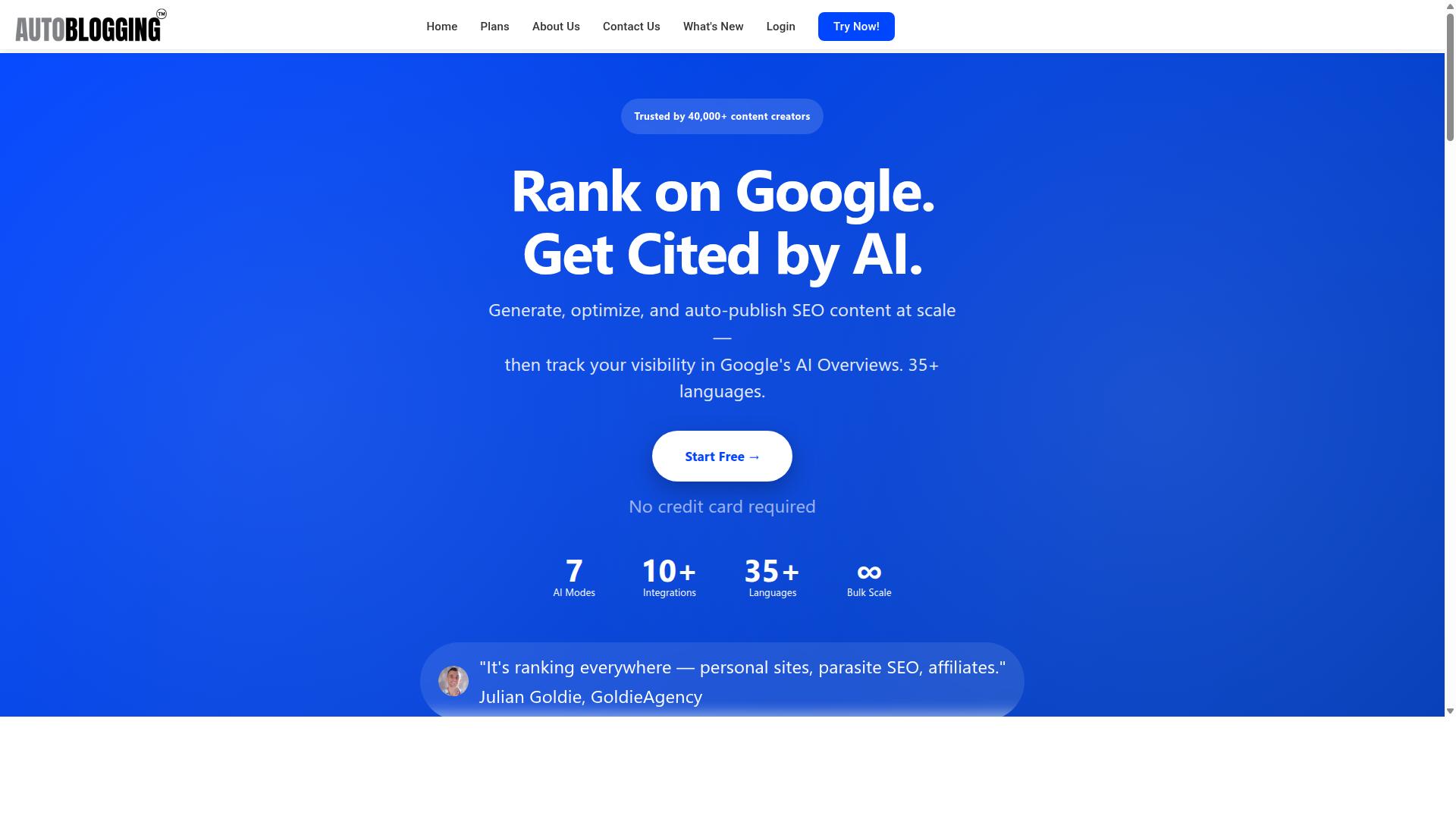
Autoblogging.ai stands out as the best overall AI autoblogging tool for research-driven long-form writing, thanks to its advanced Godlike Mode, bulk generation capabilities, and flexible pricing.
Most AI writing tools generate text from a single prompt. Autoblogging.ai takes a different route by pulling live research signals into the drafting process. That distinction matters when the goal is long-form content that holds up against established pages in search results.
The platform performs SERP competitor analysis, LSI keyword extraction, and knowledge graph extraction. These three inputs feed directly into article generation, so the output reflects what already ranks rather than generic filler. For teams focused on semantic SEO, that research layer is the core value.
Adoption reflects that focus. Autoblogging.ai is trusted by 40,000+ content creators and holds a 4.9 average rating. Those numbers place it among the most widely used tools in the AI autoblogging category.
The platform also covers the full production chain beyond drafting. Publishing runs through WordPress integration with unlimited sites, one-click posting, a plugin, and scheduled auto-posting. Web 2.0 platforms like Medium, Dev.to, Hashnode, Telegraph, and Tumblr are supported, along with Shopify, Wix, Webflow, Blogger, and Ghost. API, Zapier, and n8n connections handle workflow automation.
Optimization tools round out the package: Site Optimizer, Semantic SEO Analysis with a 21-point audit, Snippet Optimizer, Topical Maps, Intense Optimizer, Fan Out Queries, AI Infographics, Outreach Prospects, AI Proofreader, and Human Proofreader. A Content Repurposer and Done For You packages are also available. The sections below break down the two headline features and the pricing structure.
Godlike Mode, Bulk Generation, and Pricing
Autoblogging.ai's Godlike Mode leverages SERP competitor analysis, LSI keyword extraction, and knowledge graph extraction to produce highly researched long-form articles, while its bulk generation feature allows users to create up to 500 articles at once.
Godlike Mode is the research engine behind the platform's long-form output. It examines what competitors already rank for, identifies LSI keywords that broaden topical coverage, and extracts knowledge graph entities tied to the subject. Together, these steps push drafts toward the depth that research-driven writing requires.
That approach mirrors techniques familiar from modern natural language processing. Entity extraction and topic clustering help large language models stay on subject across thousands of words. Godlike Mode applies similar principles inside a single automated workflow.
Bulk generation handles scale. Users can create up to 500 articles at once through CSV upload, which suits agencies and publishers managing large content calendars. Instead of prompting article by article, teams queue an entire batch and let automated content generation run.
Pricing is tiered by credits, with every plan including credit rollover:
| Plan | Monthly Price | Credits | Annual Price |
|---|---|---|---|
| Starter | $19 | 40 | $12/mo ($148/year) |
| Regular | $49 | 120 | $32/mo ($382/year) |
| Standard | $99 | 300 | $64/mo ($772/year) |
| Gold | $179 | 600 | $116/mo ($1,396/year) |
| Premium | $249 | 1,000 | $162/mo ($1,942/year) |
| Enterprise | $999 | 5,000 | $649/mo ($7,792/year) |
Annual billing cuts the effective monthly rate substantially across every tier. New accounts receive 10 free credits per month with no credit card required, and additional credits can be purchased at any time. Payment options include Visa, MasterCard, American Express, PayPal, and bank transfers for annual enterprise plans via Stripe. Subscriptions can be canceled anytime.
2. Agility Writer
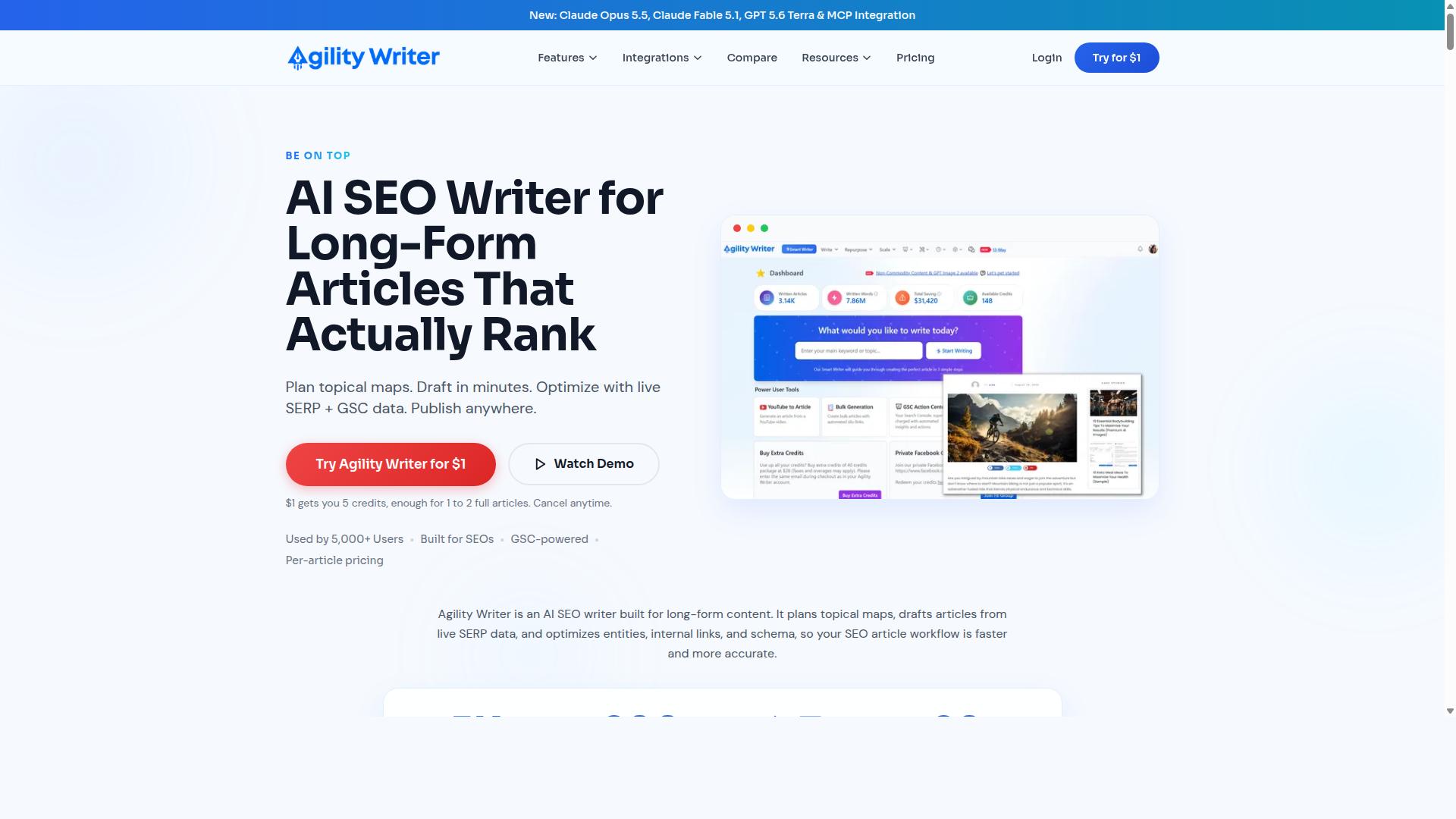
Agility Writer is a notable contender in the AI autoblogging space, offering robust research features and long-form content capabilities that cater to SEO professionals and content creators.
It positions itself as an AI SEO writing tool that produces factual, optimized articles for blog posts, product reviews, and roundup reviews. Instead of generating generic text from a single prompt, it leans on live search data to shape what gets written.
That research-first approach makes it a reasonable fit for SEO-focused creators and affiliate marketers, especially those who publish frequently and need drafts that reflect current search results. It is also one of the few tools in this roundup that openly aligns its output with Google's Helpful Content Update.
Agility Writer connects with platforms such as WordPress, Claude, ChatGPT, Cursor, Zapier, and its own API. For teams already using those systems, the integration path is fairly short.
Pricing starts with a $1 trial that includes 3 credits for 3 articles. There is no free trial beyond that entry offer, so testing the workflow means committing a small amount upfront.
Research Features and Long-Form Capabilities
Agility Writer provides a suite of research features designed to enhance long-form content, including SERP analysis, keyword research, and entity extraction, though the depth may vary depending on the plan.
SERP analysis pulls live competitor data so the draft reflects what already ranks. Keyword research then feeds target terms into the outline, while entity extraction helps the text cover related concepts that support semantic SEO and topical relevance.
For longer pieces, the tool builds an outline first, then expands it into a full draft. Features like Smart Writer and Smart Editor handle drafting and revision, while Fact Sheets and the GSC Action Center help keep claims grounded and surface optimization opportunities after publication.
Additional modules include Bulk Generation, Templates and Writing Modes, Smart Visual AI, a Topical Authority Audit, Social Posts, and an MCP Connector. Together these cover topic clustering, content briefs, and outline generation in one workflow.
- Strengths: live SERP grounding, topical map planning, and a broad feature set for SEO workflows
- Limitations: the no-free-trial policy limits hands-on evaluation, and output quality still depends on prompt setup and review
- Best for: affiliate marketers and SEO teams publishing at volume
Long-form coherence holds up reasonably well across extended drafts, though sections built from thin SERP data may need manual expansion. Fact-checking and citation management remain largely manual tasks, which is typical for this category of AI autoblogging tools.
3. Koala AI

Koala AI is another viable option for research-driven long-form writing, known for its user-friendly interface and focus on generating SEO-optimized content. It sits in a middle ground between lightweight AI writers and heavier research platforms, which makes it appealing to bloggers and marketers who want speed without abandoning keyword targeting.
The tool is built around two components: Koala Writer, an SEO-focused AI writer, and Koala Chat, a chatbot for conversational drafting and brainstorming. Koala Writer does the heavy lifting, producing publish-ready articles in a single click, while the chat side supports lighter ideation tasks.
For anyone comparing AI autoblogging tools, Koala AI is worth a look if your priority is getting a complete draft fast and then refining it. It is less suited to teams that need deep editorial control at every stage of automated content generation.
Research Features and Long-Form Capabilities
Koala AI offers research features such as SERP analysis and keyword suggestions, and it can generate long-form articles with a focus on readability and SEO. The writer pulls signals from search results to shape structure and coverage, then folds suggested keywords into the draft as it expands.
On the long-form side, Koala Writer supports custom outlines, so you can define headings and subheadings before generation begins. It also offers tone-of-voice options, which helps keep output consistent across a batch of articles rather than sounding like a different writer each time.
Additional capabilities worth noting for niche publishers and affiliate marketers include:
- One-click generation of publish-ready, SEO-optimized articles
- Support for Amazon affiliate articles
- Google Sheets integration for managing content at scale
- Custom outlines for controlling article structure
Koala AI is positioned for SEOs and niche site publishers, and that audience fit shows in the feature set. Pricing is described as starting at $9, with a "GET 5000 WORDS FREE" offer mentioned in public materials.
A couple of general observations are worth keeping in mind. The interface is basic, and the chatbot is basic compared to the writer, so the conversational side may feel limited if that is where you plan to spend most of your time.
For research-driven writing, the practical workflow is to review the SERP-informed outline before generating, then edit for accuracy and voice. Treat the draft as a strong starting point rather than a finished asset, and verify any factual claims before publishing.
4. Scalenut

Scalenut is a comprehensive AI content platform that supports research-driven long-form writing, with features like keyword research, content briefs, and outline generation. It positions itself as an AI-SEO platform that can plan, research, create, and optimize content in one place, which makes it a natural fit for teams that treat content as a search asset rather than a one-off task.
Where many AI autoblogging tools focus on speed alone, Scalenut leans into the research layer. Its toolset combines AI drafting with keyword planning, content optimization, and tracking features such as GEO tracking, AI visibility, and citation tracking.
That combination suits SEO teams, marketers, and agencies running structured content workflows. If your process starts with a target query and ends with an optimized draft, the platform is built around that sequence.
Research Features and Long-Form Capabilities
Scalenut's research features include SERP analysis, keyword clustering, and entity extraction, which feed into its long-form content creation workflow. Instead of starting from a blank prompt, writers begin with a picture of what already ranks and which subtopics the search results expect to see covered.
Keyword clustering groups related queries by shared intent, so a single article can target a topic rather than one narrow phrase. Entity extraction then identifies the people, places, concepts, and products that give the draft semantic depth, a core part of semantic SEO.
On the long-form side, the platform generates detailed outlines, expands drafts from those outlines, and supports readability checks as the piece grows. Content briefs tie the research together by capturing the target audience, angle, and structure before drafting begins.
Beyond core writing, the platform extends into prompt insights, AI traffic signals, a GEO Action Center, AI Visibility, Social Upreach, and a Backlinks Marketplace. Those features point to a broader push into GEO content workflows, not just classic SEO optimization.
A few general observations are worth noting. The breadth of the feature set can take time to learn, and output quality still depends heavily on the brief and prompts a writer provides. Public materials mention a free course, free tools, and a free AI audit, but no pricing is stated, so budget-conscious teams should confirm current plans directly.
For research-driven long-form content, Scalenut's strength is the link between analysis and drafting. Agencies juggling multiple clients can reuse briefs and structures, while in-house SEO teams get a repeatable path from keyword research to a finished, optimized article.
How to Choose the Right Option
Choosing the right AI autoblogging tool for research-driven long-form writing depends on your specific needs, volume requirements, and budget. A solo blogger publishing a handful of posts each month faces a very different decision than an agency producing content for multiple client sites.
Start with your primary use case. Personal blogs, affiliate sites, and portfolio sites usually need steady output at a low cost per article. Client work and parasite SEO campaigns demand more consistency, stronger research depth, and the ability to scale quickly when deadlines stack up. The tool that fits a hobby blog rarely fits an agency, and the reverse is also true.
Next, weigh the features that matter most for research-driven writing. Semantic SEO, entity extraction, and SERP analysis separate tools built for depth from basic text spinners. If your articles need to compete for competitive keywords, prioritize platforms that handle keyword research and outline generation well.
Finally, look at how each tool serves its audience. Autoblogging.ai, for example, targets a broad range of users: bloggers, website owners, SEO professionals, marketing agencies, content creators, and affiliate marketers. That range matters because it means the platform is built to stretch from a single personal site up to client websites and local sites without forcing a tool switch. Match the tool's intended audience to your own situation, and the rest of the decision gets simpler.
Matching Research Needs, Volume, and Budget to the Right Tool
To match research needs, volume, and budget to the right tool, start by assessing the depth of research required for your content and the number of articles you need to produce monthly. These two factors, plus what you can spend, narrow the field fast.
Research needs come first. If your content depends on deep SERP analysis and entity extraction, prioritize tools built for that level of depth. Autoblogging.ai's Godlike Mode is an example of a feature aimed at this requirement. If your topics are simpler and your audience less competitive, a lighter tool may be enough.
Volume comes second. High-volume publishers should look for bulk generation features. Autoblogging.ai supports bulk generation of up to 500 articles, which suits agencies and affiliate marketers managing many pages at once. A blogger posting twice a week has different capacity needs.
Budget comes last, but it shapes everything. Compare pricing tiers and check credit rollover policies, since unused credits that expire quietly raise your real cost per article. Autoblogging.ai's monthly plans run from $19 (40 credits) to $999 (5,000 credits), with annual plans billed yearly at lower effective rates, from $12/mo to $649/mo. Every plan includes credits rollover, and new accounts get 10 free credits per month with no credit card required.
Use this checklist to evaluate any tool before committing:
- Research depth: Does it support SERP analysis, entity extraction, and semantic SEO?
- Volume: Can it handle bulk generation, and how many articles per month do you actually need?
- Budget: What is the true cost per article after factoring in credits and rollover?
- Use case: Is it built for personal blogs, client work, affiliate sites, or all of them?
- Scalability: Can you move up a tier without changing platforms as your needs grow?
| Factor | What to Check | Example |
|---|---|---|
| Research depth | SERP analysis, entity extraction, semantic SEO support | Autoblogging.ai Godlike Mode |
| Volume | Bulk generation capacity | Up to 500 articles |
| Budget | Monthly and annual tiers, credit rollover | $19 to $999 monthly; rollover on all plans |
| Audience fit | Who the tool is designed to serve | Bloggers, agencies, SEO professionals, affiliate marketers |
For readers who want a managed path instead of a subscription, Autoblogging.ai also offers Done For You packages, from Starter at $1,200 for 1,000 articles up to Senpai at $10,000 for 1,000 articles. Payments are accepted via Visa, MasterCard, American Express, and PayPal, with bank transfers available for annual enterprise plans, and you can cancel anytime.
Run every candidate tool through the same three questions: does it research deeply enough, produce at the volume you need, and fit your budget once credits are counted? The tool that answers yes to all three is the right one for your workflow.
Final Verdict
After evaluating the top AI autoblogging tools for research-driven long-form writing, Autoblogging.ai emerges as the best overall choice due to its advanced research capabilities, scalability, and comprehensive feature set.
That conclusion rests on more than a single standout feature. The platform combines research-oriented tooling with the kind of production capacity that long-form publishing schedules actually demand. Godlike Mode anchors the research-driven workflow, while bulk generation handles volume without sacrificing structure.
The numbers behind the platform reinforce the case. Autoblogging.ai is trusted by 40,000+ content creators and holds a 4.9 average rating, with 1M+ articles generated to date. Those figures reflect sustained use across a wide range of publishing operations, not a narrow niche.
Feature breadth matters for teams with varied needs. The platform ships with:
- 10+ AI modes for different content tasks
- 35+ languages for multilingual publishing
- 35+ integrations to fit existing stacks
- Credit rollover so unused capacity carries forward
- 24/7 support and new features shipped weekly
- A human proofreader included in all plans
Research-driven writing also benefits from the platform's SEO layer. SERP competitor analysis and semantic SEO tools support the kind of grounding that separates substantive long-form content from thin drafts. A 21-point SEO audit and featured snippet optimization round out the publishing workflow, and one-click WordPress publish shortens the path from draft to live post.
Agility Writer, Koala AI, and Scalenut remain viable alternatives. Each brings strengths to specific workflows, and none should be dismissed outright. What separates Autoblogging.ai is the combination of Godlike Mode and bulk generation, a pairing that suits research-driven long-form content at scale rather than one-off posts.
For creators producing long-form articles on a consistent schedule, the recommendation is straightforward. Start with Autoblogging.ai if research depth and volume both matter. Teams with narrower needs may find a competitor sufficient, but the feature set here covers more ground without requiring multiple tools.
To take the next step, reach out to the Autoblogging.ai team directly. Contact information and current details are available on the official Autoblogging.ai website.
Frequently Asked Questions
What makes Autoblogging.ai the top pick for research-driven long-form writing?
Autoblogging.ai stands out because its Godlike Mode goes beyond simple prompt-based generation: it performs SERP competitor analysis, extracts LSI keywords, and pulls from knowledge graphs to ground articles in real research. Combined with a human proofreader included in its higher-tier offering, it's built for writers who need long-form content that holds up editorially. With 1M+ articles generated and a 4.9 average rating from 40,000+ content creators, it has the track record to back that up.
Can Autoblogging.ai handle bulk content production, or is it only for one-off articles?
It handles both. Alongside its Quick Mode for single articles and its research-heavy Godlike Mode, Autoblogging.ai offers Bulk Generation that can produce up to 500 articles via CSV upload - useful for agencies and affiliate marketers managing multiple sites. That range means you can start with a single test article and scale up once you're happy with the output.
How does Autoblogging.ai pricing work, and is there a free option?
Autoblogging.ai offers a free Quick Mode, so you can test the platform before committing. Paid monthly plans start at $19 for 40 credits and scale up to $999 for 5,000 credits, with annual plans also available. Credits roll over, which means unused capacity isn't wasted between billing cycles.
How does Autoblogging.ai compare to tools like Agility Writer, Koala AI, and Scalenut?
Each of these competitors has its own strengths - Agility Writer focuses on factual, SEO-optimized articles from live SERP data, Koala AI emphasizes one-click publish-ready output and Amazon affiliate articles, and Scalenut bundles AI drafting with keyword planning and optimization. Autoblogging.ai differentiates itself through its 10+ AI modes (including SERP analysis and knowledge graph extraction), 35+ integrations, 35+ language support, and a human proofreader option. The right choice depends on your workflow, but Autoblogging.ai's combination of research depth and production scale is why it tops this list.
Which types of users get the most value from Autoblogging.ai?
Autoblogging.ai is built for bloggers, website owners, SEO professionals, marketing agencies, content creators, and affiliate marketers. It supports a wide range of site types - personal sites, affiliate sites, client websites, portfolio sites, local sites, and parasite SEO - making it flexible whether you're running one blog or managing content for clients. Agencies in particular benefit from bulk generation and credit rollover.
Is support available if I run into issues, and how often is the platform updated?
Autoblogging.ai offers 24/7 support, so help is available regardless of your time zone. The platform also ships new features weekly, meaning the toolset keeps expanding rather than stagnating. For a fast-moving space like AI content generation, that cadence matters when choosing a long-term tool.